The Real Ross & Gladys
Ross & Gladys Preston
The first people who ever lived in Lawhoma Hills
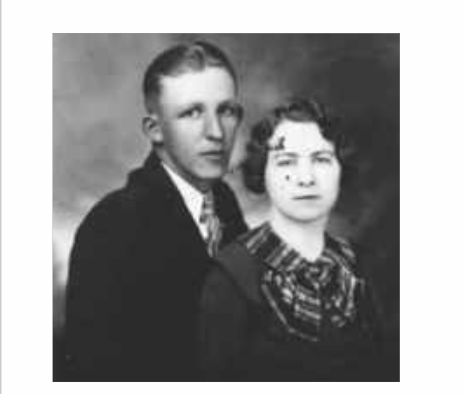
[ Ross Lane Zwingle and Gladys Lout, married April 11, 1931, Anadarko, Oklahoma]
Before there was a Lawhoma Hills, there was life on 44th Street.
Ross Lane Zwingle was born in Tennessee in 1909 and married Gladys Lout in Anadarko, Oklahoma, in the spring of 1931. She was born in Indian Territory, six years before Oklahoma was a state. They lived for many years in southern Oklahoma and spent a stretch in Long Beach, California. He registered for military service in 1942.
By the time I knew them, they were the old couple next door.
In the acknowledgments of A Year Behind the Pink Door, I wrote this:
For Ross and Gladys, our neighbors on 44th. Thank you for teaching me about a garden—how to get used to the sticky itch from picking okra, for sharing the mimosa tree on our property line, and most of all for letting me use the honeysuckle vines on our fence row as my first set of hurdles.
I don’t know if I am an odd writer or if most authors find reference and inspiration in people, places, and events from real life to create characters in the worlds we write our books about. The acknowledgment lines I added to the first adult novel were only the short version of where Ross and Gladys Preston came from. Here is a bit more on why they came to life in Lawhoma Hills.
Neighbors as Family
Ross was always in overalls and a straw garden hat, and never without a wad of chewing tobacco in his cheek. His old blue Chevy truck sat in their drive, and I can still see it there.
He taught me about soil. How deep to put a seed in the ground. How to keep picking okra even after the itch sets in and your arms are on fire. He taught my older brothers how to use carpentry tools, which is the kind of thing a man does when he has time and nobody expects it of him.
The mimosa tree stood right on our property line, and he let us make it the “fort” in our wild country kid’s play. I got in trouble more than once for jumping the honeysuckle vines on the fence row, and then he let me do it anyway.
When they got a fancy riding mower, he let me mow their yard every single time I asked. I was a kid. I thought it was a treat. I did not understand then that a man was handing a child something and asking for nothing back.
Gladys baked and cooked and worried over every one of us. My best times with her were in her kitchen and in fall, sitting on the screened- in-porch on the back side of their house, looking out over the big prairie pasture. She was a confidant and friend to my mother, and a support during some rough years. Gladys sat out there with us and listened, always in her apron and SAS shoes.
They had a scrawny, quite frankly mean dog named Ladybird. I vividly remember she was one of those little Chihuahua dogs that had a tongue bigger than her mouth and she was ornery and snappy, but she is still there in my mind—they loved her for years as she too grew old.
Ross and Gladys never had children of their own. So in Lawhoma Hills I gave them two sons—Ranger and Ozzy. I watched them parent all of us, and I know what kind of men they would have raised. The whole motley crew of us living next door were safer and better with their eyes on us and their hands reaching for us.
I did not know about Ross's time serving in WWII. I was a kid on a riding mower, and nobody tells a kid on a riding mower what a man did in 1942. I did not appreciate the life lived behind the eyes that watched over my childhood.
Life hands you people you do not deserve, and does not let you see, at the time, the generosity in every small ordinary thing.
We moved off 44th Street when I was in ninth grade. We stayed in touch, but I never knew their family—only distant nieces and nephews I never met. I remember my mother was heartbroken when Gladys was moved to Arizona after Ross’s passing.
Ross died in Oklahoma City in 1993. Gladys died in Payson, Arizona, in 1998, at ninety-four.
They are both buried in Chickasha, Oklahoma.
She went out to Arizona, and she came home to Oklahoma ground.
In Lawhoma Hills, Ross and Gladys Preston have an orchard, a booth at the Saturday farmers market, and 163 acres along Blue Creek Lake that a development company would very much like to have.
I hope each of you have people like Ross and Gladys in your lives—family does not need to be blood and shared ancestry. I hope that meeting them as real people, readers will see the love behind these characters in Lawhoma Hills. The bones of fiction come from the lives and experiences of the authors behind it. Ross and Gladys Preston grew from two people that made a difference in my feral Oklahoma childhood and adolescence. I never appreciated it then and only hope they somehow know now—they did raise kids, and this one is a better person because of them.
Read about Ross and Gladys Preston:
They are in A Year Behind the Pink Door, available now.
The season changes for them in When the Rain Did Not Come, out November 9.
This is the first in a series about the real people behind the families of Lawhoma Hills. More at lawhomahills.com/gazette
Lawhoma Hills, Oklahoma
